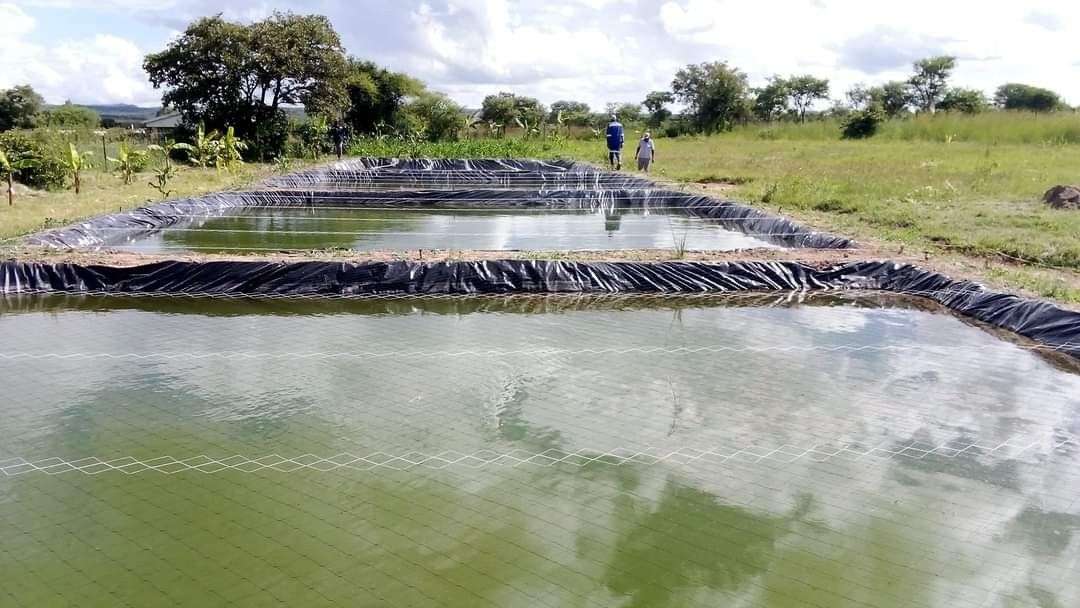
Fishpond liner price in Kenya starts from KES 210 to KES 450 per meter square. Fish pond liners are essential in fish farming. They are effected as fish pond lining materials due to their waterproof design and long-lasting design. Buy quality fishpond liners in Kenya from Faulu Irrigation LTD at prices from as low as KES 210 per square meter.
Call 0717120401
Why Fishpond Liners are Best for Fish Farming
Fish pond liners, made of quality UV treated material can hold water effectively and for a long time in all soils. It is a strong fabric with non-reactive composition that makes it good for fish and soil safety.
Fishpond Liners for Sale in Kenya
A fishpond liner is a stable UV resistant plastic earth liner made from Polyethylene for use in fishpond water retention. With a top-quality fishpond liner, you can store water and rear fish in areas with highly permeable soil. Harvested rainwater or river water can be pumped to the fishpond so long as it is clean.
Fishpond Liner Price in Kenya
Fishpond liner price in Kenya per square meter for the available fishpond liner sizes is listed below:
- 0.3 mm – KES 210
- 0.5 mm – KES 240
- 0.75 mm – KES 330
- 1.0 mm – KES 430
How to Use Fishpond Liners in Kenya
The right way to use fishpond liners is by laying it on the ground surface and use soil to hold it in place. A fishpond whether excavated or made of raised concrete is covered with a fish pond liner of your choice. The most ideal one is a 1 mm fishpond liner as it would exhibit more resistance to puncture and would last longer.
Before you lay the liner, remove stones or objects that could interfere with smooth surface lining of the material. In case the fishpond requires more than 1 roll of the liner, you have to join the liners using a hot welding machine.
Another important thing is having a 1m extension on the dam liner for anchorage onto the ground. Tuck the extension onto the trench and bury with soil.
Things you Should Know When Buying Fish Pond Liners
- Understand the shape of your fishpond – the shape of the fishpond is important for accurate estimation of the dam liner size required.
- Know the dimensions of the fish pond – We often use the pond measurements to calculate the pond liner that will fit the pond.
- Understand the soil structure – the structure of soil in your fishpond will help determine which pond liner gauge to use. For rough soil, we recommend 1 mm liner.
- Depth of your pond – also required for estimation of the dam liner.
- Are the pond edges slanted or straight? – slanted edge ponds will take a different size of a liner compared to a fishpond with straight vertical edges.
Correct Way to Fit a Fishpond Liner
Fishpond liners are installed by the following steps:
- Surface Leveling and preparation – digging the surface to obtain a level and removing obstacles. Sand can be used to make the ground level.
- Unpacking the fishpond liner roll – opening and unpacking the fishpond liner roll and cutting to match the sizes of the base and the walls.
- Laying the pond liner roll – spread the fishpond liner over the base of the pond.
- Holding the liner extension to the ground – Bury the pond liner extension on the shallow trench on the surface around the pond. You can also use bricks to hold the liner
- Welding the liner pieces – join the base liner to every individual liner on the walls using a hot welding machine.
- Test the pond liner for punctures – Pump water to the fishpond and watch the level after some few hours. If water level drops, the liner was not jointed well and needs to be redone.
Fish Pond Liner Applications
- Fish rearing – tilapia, tuna, catfish, jellyfish and Omena
- Crab farming – rearing of crabs
- Oysters – can also be used to keep oysters.
- Aesthetic fishpond lining – to store water in decorative fishponds.
Benefits of Fishpond Liners in Kenya
- Allows for convenient fish production at low cost.
- The material is safe for fish and environmental use.
- Boost income generation through production of fish species that fetch high prices
- Improves food security due to increased production of fish, crabs and oysters.
- Safeguards the ecosystem by enhancing rearing of extinct fish species.
- Enhances fish research and aquatic management.
- Provides warm and convenient surfaces for breeding of fish.
Leave a Reply