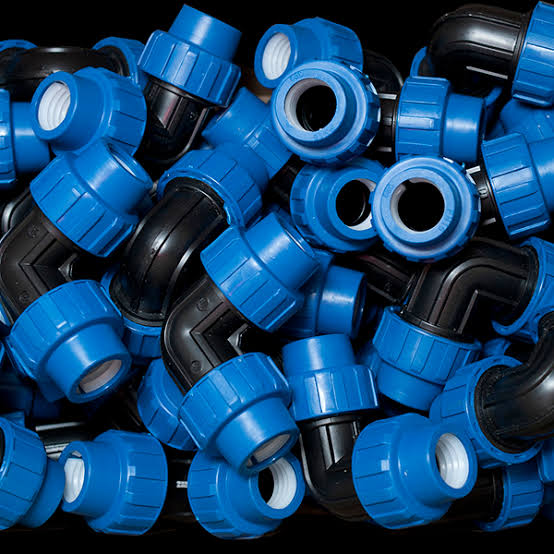
HDPE Pipe fittings available in sizes of 20 – 110mm are sold at Faulu Irrigation LTD. We have the best-quality fittings, including tees, elbows, couplings, and end caps. Our HDPE Pipe fitting prices range from KES 100 – KES 3,000 depending on the size and type.
Call 0717120401
HDPE Pipe Fittings
HDPE stands for High-Density Polyethylene. These pipe fittings are used to connect HDPE pipes for home and agricultural water supply pipes.
HDPE Pipe Fittings Prices in Kenya
| HDPE fitting | Price |
| Coupling | 100–1,400 |
| Elbow | 150–1,400 |
| Tee | 150–1,900 |
| End cap | 100–900 |
| Male/female adapter | 100–920 |
| Reducing coupling | 250–1,611 |
| Saddle clamp | 80–2,500 |
Types and Uses of HDPE Pipe Fittings
- Couplings: Connect two HDPE pipes of the same diameter.
- Elbows: Change the direction of water flow, commonly by 45 or 90 degrees.
- Tees: Divide water from one pipeline into two branches.
- Reducers: Connect pipes with different diameters.
- Saddle clamps: Create additional outlets from an existing pipeline.
- Male and female adapters: Connect HDPE pipes to threaded valves, pumps and taps.
- End caps: Close unused pipeline ends and prevent water from escaping.
How to Connect HDPE Pipe Fittings
- Measure and cut the HDPE pipe squarely using a suitable pipe cutter.
- Clean the pipe end and remove dirt, burrs and damaged sections.
- Loosen the fitting nut and prepare its sealing components according to the manufacturer’s instructions.
- Insert the pipe fully into the fitting body until it reaches the internal stop.
- Tighten the nut using a pipe wrench. Avoid overtightening.
- Introduce water gradually and inspect the joint for leaks.
HDPE pipe fittings are best for irrigation systems because they are easy to connect.
Irrigation Systems That Require HDPE Pipe Fittings
- Drip irrigation: Couplings, tees, and adapters connect mainlines to smaller distribution pipes supplying water near crop roots.
- Sprinkler irrigation: Elbows, tees and threaded adapters connect water supply pipelines to sprinkler equipment and valves.
- Rainhose irrigation: Reducers and connectors distribute water between different growing sections.
Common Uses of HDPE Fittings
Beyond irrigation, HDPE fittings have several applications in agricultural and domestic water infrastructure. Farmers use them for borehole connections, water tank outlets, livestock drinking systems, farm water distribution and water transfer between storage reservoirs.
Saddle clamps are especially useful when extending an existing pipeline because they provide a branch connection without replacing the entire mainline. Adapters also make it easier to connect polyethylene pipes to threaded pumps, taps and valves.
An important consideration is accessibility: place frequently used joints and valves where they can be inspected and repaired easily. Burying every connection may reduce exposure to sunlight, but it can make maintenance unnecessarily difficult.
Advantages of HDPE Fittings Over PVC Fittings
- Highly durable: HDPE fittings are more durable due to their UV-resistant manufacturing compound.
- Corrosion resistance: does not corrode or react with chemicals.
- Easier to join: easy to join and disconnect
HDPE’s flexibility helps pipelines accommodate uneven ground and movement. Its resistance to corrosion also makes it suitable for long-term water distribution. However, PVC can be cheaper and is perfectly suitable for many fixed installations. The best choice depends on pressure, pipe design, soil conditions and installation costs.
How to Choose the Right HDPE Fittings for Your Farm
Before purchasing, establish your pipe diameter, operating pressure and irrigation requirements. A pipe fitting must match the outside diameter and pressure rating of the pipe.
Follow the guidelines below when choosing the right fitting to buy:
- Check the pipe diameter before ordering.
- Match the fitting’s pressure rating to the system pressure.
- Choose UV-resistant fittings.
- Buy quality fittings with reliable sealing components.
- Confirm compatibility with the connection pipes.
Quick Takeaways
- HDPE fittings connect pipes, redirect water and distribute irrigation flow.
- Prices in Kenya vary according to diameter, quality and fitting type.
- Common fittings include couplings, elbows, tees, reducers and saddle clamps.
- Compression fittings are convenient for small and medium-sized farm irrigation systems.
- Drip, sprinkler and greenhouse irrigation systems all use HDPE fittings.
- HDPE offers flexibility, impact resistance and corrosion resistance compared with rigid PVC.
- Always match fitting diameter and pressure rating to the pipe specifications.
Frequently Asked Questions
1. How much do HDPE pipe fittings cost in Kenya?
KES 100 – KES 3,000 for 16mm – 110mm size.
2. What are the common types of HDPE pipe fittings?
couplings, elbows, tees, reducers, saddle clamps, adapters, connectors and end caps.
3. Where can I buy HDPE pipe fittings in Kenya?
Faulu Irrigation LTD
4. How do you connect HDPE pipe fittings?
For compression fittings, cut the pipe squarely, clean its end, insert it fully into the fitting and tighten the nut according to the manufacturer’s instructions.
5. Are HDPE fittings suitable for drip irrigation?
Yes. They connect mainlines, sub-mainlines and driplines.
6. What size HDPE fittings should I buy?
It depends on the irrigation system, pipe diameter and pressure needs.
7. Are HDPE compression fittings reusable?
Fittings can be reused if their bodies, threads and, sealing components remain undamaged.
8. Are HDPE fittings suitable for underground irrigation?
Yes. HDPE fittings can be used underground, provided they are installed correctly.
Leave a Reply